TL;DR
- AI visibility is how often, how early, and how accurately AI tools bring up your brand when shoppers ask for recommendations. It is not a single rank.
- One answer is a screenshot. Ask the same prompt several times and analyze every answer — six mentions out of eight is a measurement.
- Seven metrics carry it:
- Mention rate — how consistently you appear
- Answer position — how early you get brought up
- AI share of voice — your slice of the brands AI actually names
- Product visibility — which products AI understands and recommends
- Citations — which domains get credit, and how often yours does
- Answer accuracy — whether AI gets your facts right
- AI traffic and revenue — what it is worth in sessions and orders
- A summary score is not a roll-up of these seven — know what yours actually contains before reading a swing in it as a change in how often AI recommends you.
What is AI visibility?
AI visibility is the measurable presence of a brand, product, or website inside answers generated by tools such as ChatGPT and Gemini for a defined set of customer prompts.
It is not a search ranking. AI answers change between platforms and between repeated executions of the same prompt: a brand may be recommended first in one answer, mentioned late in another, and omitted entirely in the next. So measure patterns, not screenshots.
The work of improving that presence goes by several names — AEO, GEO, or AI SEO. This article is about the measurement side.
Why one answer is not enough
Running a prompt once tells you what one execution returned. It does not tell you the probability that a shopper will see your brand.
The reason is that large language models are non-deterministic: the same prompt can return a different answer every time it runs. Sampling randomness, silent model updates, and whatever sources happen to be retrieved in that moment all move the output — so the same question asked twice, minutes apart, can name different brands in a different order.
Repeat the same prompt under a documented setup and analyze every successful answer. Record the exact prompt, the platform and model, date and market, browsing state, number of executions, failed or excluded executions, and your aggregation method. Location settings are not uniform across platforms — record where a market could not be applied, so comparisons never silently mix the two.
Visibly AI works this way: each refresh runs a prompt several times across several models and analyzes each answer independently. On Shopify that is four answers per prompt per refresh on Starter (ChatGPT, every two weeks) and eight on Pro — four ChatGPT, four Gemini, weekly.
The seven metrics
| Metric | How to calculate it | What it reveals |
|---|---|---|
| 1. Mention rate | Answers mentioning your brand ÷ successful answers | How consistently you appear |
| 2. Answer position | Average position of your brand's first appearance, across answers where it appears | How prominently you appear when included |
| 3. AI share of voice | Your appearances ÷ appearances of every brand named in the same answers | Your visibility relative to the brands AI actually names |
| 4. Product visibility | Whether AI can identify and recommend the product, and whether the page gives it what it needs | Which products AI understands |
| 5. Citations | Which domains the answer cites, and how often yours is among them | Who gets credit for the answer |
| 6. Answer accuracy | Correct evaluated claims ÷ evaluated claims | Whether AI describes you correctly |
| 7. AI traffic and revenue | Sessions, orders, and revenue from identifiable AI referrals | The measurable business outcome |
1. Mention rate
The percentage of successful answers that include your brand — six of eight answers is 75%. More useful than a yes-or-no check because it exposes instability: a brand that appears once is not as visible as one that appears consistently. Track it by prompt and by platform; a combined average can hide the loss of an entire platform.
2. Answer position
Position measures where you show up, not just whether. An answer may name ten brands while genuinely recommending the first three. There are two honest definitions, so state which you use: position in the recommendation set, or position in the answer text.
Visibly AI reports the second — the average position of your brand's first appearance in the answer. A value of 3.0 means AI typically brings you up around the third sentence, not that you are the third brand recommended. Lower is better. Answers that omit the brand are reported through mention rate, never assigned an arbitrary position.
3. AI share of voice
The denominator is the decision that matters. A fixed competitor list is simple, but the percentage shifts whenever you edit the list and it is blind to competitors you never thought to track.
Visibly AI uses the alternative: every answer is scanned for the brands it recommends or lists as alternatives, and your share is measured against that discovered set. Both sides count presence per answer, so one verbose mention cannot inflate a share. Editing your tracked competitors changes what the dashboard highlights, not the share itself.
Break share of voice down by customer need — a healthy average can hide a competitor owning your highest-intent prompts.
4. Product visibility
Brand visibility alone is not enough for ecommerce, and this splits into two questions measured differently.
Can AI find and recommend the product? Measure this on prompts where the item is genuinely relevant, and check whether AI gets the variant, price, material, size, or compatibility right.
Does the page give AI what it needs? You can measure this today without waiting for an answer. Visibly AI audits each tracked product page against the eight things a buyer — and an assistant acting for them — needs: what it is, specs, use cases, needs and benefits, who it is for, limitations, evidence, and why to choose it over alternatives. Buried information earns partial credit at best; roughly 44% of LLM citations come from the first 30% of a page's text.
Page readiness is the lever you control. Answer-side recommendation is the outcome you are moving.
5. Citations
Two things, and they are not the same. Which domains keep showing up — the retailers, review sites, publishers and forums competing for the model's attention in your category. And how often your own domain is among them: Visibly AI reports this as the share of cited answers that cite one of your domains, over a rolling 90-day window, with a minimum volume before it will report a number rather than a noisy fraction.
Don't confuse a citation with a mention. AI may recommend your product while citing a retailer — or cite your page without recommending you.
6. Answer accuracy
Visibility is not automatically positive. An answer can mention your brand and still give the wrong price, claim a feature you don't offer, or repeat outdated information. Grade important claims as correct, partially correct, incorrect, or not verifiable.
This one is still a human job. Tooling — including Visibly AI today — does not grade factual accuracy for you. What it gives you is the raw material: every stored answer, so you review what was actually said instead of reconstructing it.
7. AI-attributed traffic and revenue
Visibly AI reads this from your Google Analytics 4 property — sessions, orders and revenue whose source resolves to an AI assistant — alongside whole-site totals.
It is knowingly incomplete. Assistant apps often drop the referrer, so those sessions land as direct; answers read without a click never produce a session; and shoppers discover you in an AI answer then arrive via Google, a marketplace, or another device. Industry estimates put the captured share at roughly 10–30%, which is why the dashboard shows both a measured figure and an estimate of the uncaptured share. Whichever you report, label it: measured AI traffic is a lower bound on influence, not a count of it.
One signal the seven miss
They tell you whether and where AI talks about you, not how. Two brands can hold the same mention rate while one is described as the reliable default and the other as the cheap option. Visibly AI tracks that separately as brand sentiment and familiarity — slower-moving, and closer to what the models have actually learned about you.
How often should you measure?
- Weekly: core buying prompts, launches, promotions, fast-moving categories
- Every two weeks: stable evergreen prompts for smaller teams
- Monthly: accuracy audits, citation patterns, strategic review
- Before and after a change: page rewrites, new collection guidance, FAQ work
Avoid changing several things at once if you want to learn what moved the result.
What should an AI visibility tool show?
The exact prompts tracked; the raw answers, not just a score; how many independent answers were analyzed and on which platforms; mention rate, position, citations and competitors side by side; and the line from a visibility gap to the page that needs work.
Then ask the question most teams skip: what goes into the score? A score built from brand authority signals and a metric built from prompt answers move at different speeds for different reasons, and confusing the two is the most common way teams misread their own data.
How Visibly AI measures ecommerce visibility
| Metric | What Visibly AI shows |
|---|---|
| Mention rate | Live, per prompt and platform, with period comparison |
| Answer position | Live — average position of your first appearance in the answer |
| AI share of voice | Live — against every brand discovered in the same answers |
| Product visibility | Page-side today: an eight-question audit and action plan per product page. Answer-side recommendation tracking is on the roadmap |
| Citations | Live — cited domains by frequency and platform, plus how often yours is cited |
| Answer accuracy | Not automated. Every raw answer is stored for review |
| AI traffic and revenue | Live via GA4 — measured AI sessions, orders and revenue, plus a modelled estimate |
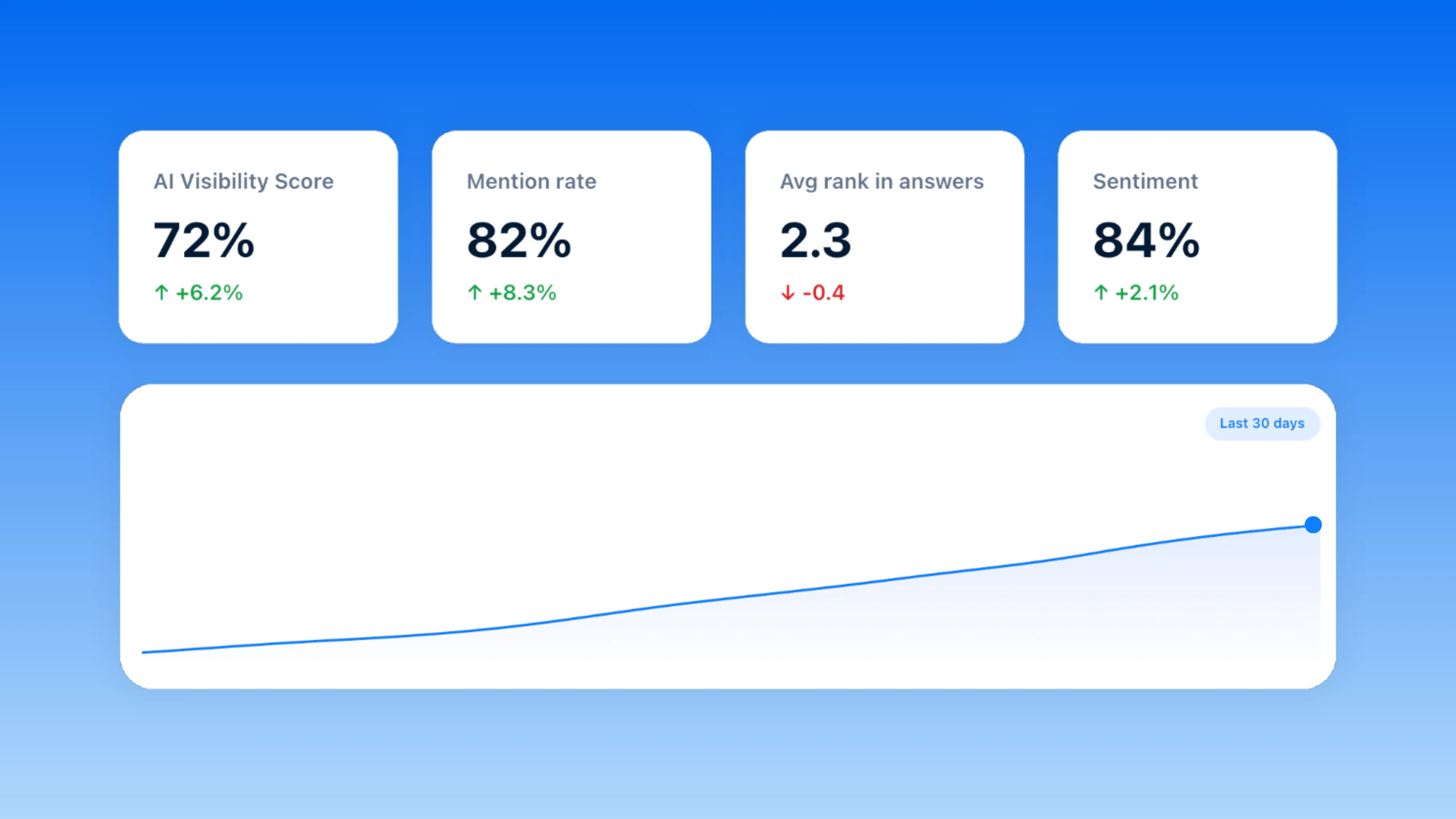
The dashboard also shows an AI Visibility Score (0–100). It is a brand-standing index — third-party domain authority, how widely and recently your brand is discussed across the web, and how favourably AI models describe it unprompted. It is deliberately slow-moving and not a roll-up of the seven metrics: a mention-rate swing this week shows up in your mention rate, not your score.
Starter ($79/mo) tracks ChatGPT, four answers per prompt every two weeks. Pro ($199/mo) tracks ChatGPT and Gemini, eight answers per prompt every week. Both include a 14-day free trial, once per store, on Shopify or the web.
If you are weighing the alternatives, we compared the main options in our roundup of the best AI visibility apps for Shopify. No tool can guarantee an AI system will recommend a brand. The value is replacing guesswork with a repeatable measurement and improvement process.
The takeaway
Measure how often your brand appears, how early, which products get recommended, which sources support the answer, whether the facts are right, and what business outcomes follow — then know which of those your summary score does and does not contain.
That is how a team moves from "Does ChatGPT know us?" to "Which visibility gap should we fix next?"
Start a 14-day Visibly AI trial on Shopify.