

TL;DR
- Webflow analyzed more than 2,000 US company websites: on average, a brand appeared in only 16% of relevant AI answers and earned a link citation just 6% of the time.
- When brands do appear, AI often gets the facts wrong — and almost never explains what makes them different from competitors.
- The causes are surprisingly basic: broken links, missing page information, and content that hasn't been updated in months.
- Ecommerce brands have the most at stake — AI needs clear facts about price, features, and shipping before it can confidently recommend a product.
- Getting ready pays off: the most AI-ready companies get 2.3x more mentions and 3.7x more citations than the least ready.
Webflow recently analyzed more than 2,000 company websites to see how visible they are in tools like ChatGPT, Gemini, Claude, and Perplexity. The result is pretty clear: most brands are not ready. The average company appeared in only 16% of relevant AI answers and received a link citation just 6% of the time.
For ecommerce brands, this matters even more. Customers are starting to ask AI what to buy, which products are best, and which brands they should trust. If your store is not included in the answer, you may lose the customer before they ever visit your website.
AI discovery is already happening
More people are using AI tools to research products and make buying decisions. Instead of searching Google for "best carry-on suitcase," a shopper might ask ChatGPT:
"What is the best lightweight carry-on suitcase under $200?"
The AI will usually recommend a small number of products or brands, and that changes the competition. On Google, a customer may scroll through several results. In an AI answer, they may only see three or four recommendations. If your brand is not included, you are invisible during an important part of the buying journey.
What Webflow found
Webflow studied more than 2,000 US company websites and measured how they appeared across several major AI platforms. The median company:
- Appeared in only 16% of relevant AI answers
- Received a link citation in just 6%
- Had an accuracy score of 63 out of 100
- Scored only 24 out of 100 for communicating what made the brand different
- Received an overall AI readiness score of just 2 out of 5
In other words, most companies are rarely mentioned. And when they are mentioned, the answer is often incomplete, generic, or not fully accurate.
How AEO maturity levels work
Webflow's AEO Maturity Model scores each company from level 1 ("still at decent SEO") to level 5 ("expanded to great AEO") across four categories: the content you publish, the technical readiness of your website, the authority other sources grant you, and your ability to measure the results.
The distribution above shows how early it still is. Nearly three quarters of companies sit at level 2, and essentially nobody has reached levels 4 or 5 yet. Level 3 is today's ceiling in practice — and it already pays off, with a 2.3x higher mention rate and a 3.7x higher citation rate than level 1.
Why are most websites performing so poorly?
The biggest problems are not complicated. Webflow found that content and technical readiness were the weakest areas. For example:
- 62% of companies had broken internal links
- 60% had missing SEO metadata
- 54% had updated less than 10% of their content in the previous six months
Most websites were simply not giving AI systems enough clear, current, and trustworthy information.
A lot of website copy is also still vague. Brands say they are "premium," "innovative," or "built for modern customers," but that does not help an AI assistant understand who the product is for, what problem it solves, or why it should recommend it. AI needs facts.
This matters even more for ecommerce stores
These findings apply to every website, but ecommerce brands have more at stake. An ecommerce store may have hundreds of products, changing prices, new collections, different sizes, changing inventory, shipping rules, reviews, and return policies. AI tools need to understand all of that before they can confidently recommend a product.
For example, a shopper might ask:
"What is the best waterproof backpack under $150 for someone who travels frequently?"
To recommend your product, AI needs clear information about:
- Price
- Materials
- Size
- Water resistance
- Use cases
- Product features
- Reviews
- Shipping
- Availability
If that information is missing, vague, buried, or inconsistent, the AI may recommend a competitor instead.
This is especially relevant for Shopify stores. Many Shopify product pages have a short description, a few images, and basic product details, and collection pages often contain little more than a product grid. That may be enough for someone who already knows the brand. It is not always enough for AI to understand why the product should be recommended.
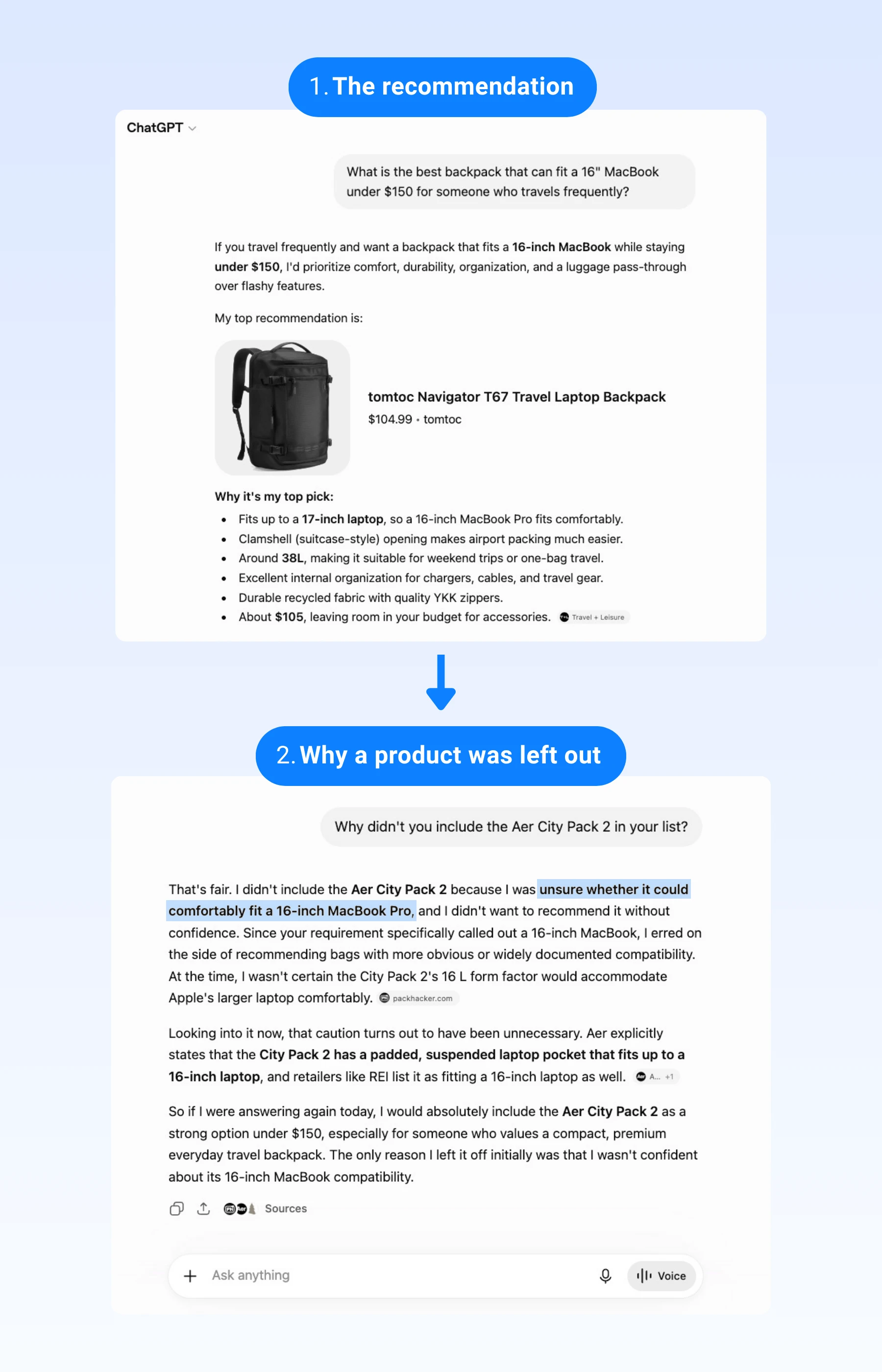
The example above shows how this plays out in a real conversation. A shopper asked ChatGPT for the best backpack that can fit a 16-inch MacBook under $150 for someone who travels frequently, and ChatGPT recommended a product it could verify against every requirement.
When asked why the Aer City Pack 2 was not on the list, ChatGPT explained that it was not sure the bag could comfortably fit a 16-inch MacBook Pro — one of the requirements — so it did not want to recommend it without confidence. After double-checking, the backpack met that requirement all along: Aer's own documentation describes a padded laptop pocket that fits up to a 16-inch laptop.
The takeaway: simply stating clearly on the product page that the backpack is compatible with a 16-inch MacBook Pro could be enough for it to be recommended in this exact prompt. One missing product detail can cost the recommendation.
Product and collection pages need to do more
A strong product page should clearly explain:
- Who the product is for
- What problem it solves
- Its most important features
- Materials or ingredients
- Size and compatibility
- How it compares with alternatives
- Shipping and return information
- Common customer questions
Collection pages also matter. They should explain what the collection is for, how the products are different, and how a customer should choose between them. For example, a coffee collection page should not only show bags of coffee — it should explain roast levels, flavor profiles, brewing methods, acidity, and which coffee is best for different preferences. That information helps both shoppers and AI systems.
Your website is only part of the answer
Webflow also found that authority plays a major role in AI visibility. AI tools look beyond your website: they compare information across reviews, publications, industry websites, comparison articles, marketplaces, and other trusted sources. This means your brand needs to be clearly represented across the web.
A strong website helps. But so do:
- Product reviews
- Press coverage
- Industry mentions
- Expert recommendations
- Comparison articles
- Customer discussions
- Credible third-party listings
The more consistent and trustworthy the information is, the easier it becomes for AI to understand and recommend your brand.
The biggest mistake is not measuring it
Most brands still have no idea how they appear in AI answers. They may see some traffic from ChatGPT or Perplexity in Google Analytics, but that only captures direct clicks. A shopper may discover your product through ChatGPT, then search for your brand on Google and purchase later. Analytics will usually credit Google, even though AI influenced the decision.
That is why traffic alone is not enough. Brands should also track:
- Which questions cause their brand to appear
- Which products are recommended
- Which competitors appear instead
- Whether AI links to their website
- Whether the information is accurate
- How visibility changes over time
What ecommerce brands should do now
The good news is that most competitors are still early. Webflow found that companies with stronger AI readiness had much better results: businesses at maturity level 3 had a 2.3 times higher mention rate and a 3.7 times higher citation rate than those at level 1.
Brands should start with a few practical steps:
- Improve product and collection page content.
- Answer the questions customers actually ask.
- Keep product, pricing, shipping, and policy information current.
- Fix broken links and missing page information.
- Build authority through credible mentions and reviews.
- Measure where the brand appears in AI answers.
Where Visibly AI fits
This is exactly why we built Visibly AI. It helps ecommerce brands and Shopify stores understand how they appear in ChatGPT and Gemini. It shows:
- Your AI Visibility Score
- Which customer prompts mention your brand
- Which products and competitors are recommended
- How often your brand appears
- Which sources AI tools use
- What you can improve on your product pages, collection pages, FAQs, and other content
- How much measurable traffic and revenue is coming from AI
It also runs prompts multiple times, because AI answers can change from one execution to another — looking at one answer is not enough to understand your real visibility.
The goal is not just to give you another dashboard. It is to show you where your brand is missing, why it may be missing, and what you should improve next.
The takeaway
Most websites are not ready for AI discovery. That creates a problem, but also an opportunity. Customers are already asking AI what to buy, and the brands that start measuring and improving their visibility now will understand this new channel before most of their competitors do.
Because when AI recommends only a few products, being left out of the answer means being left out of the customer's decision.