
TL;DR
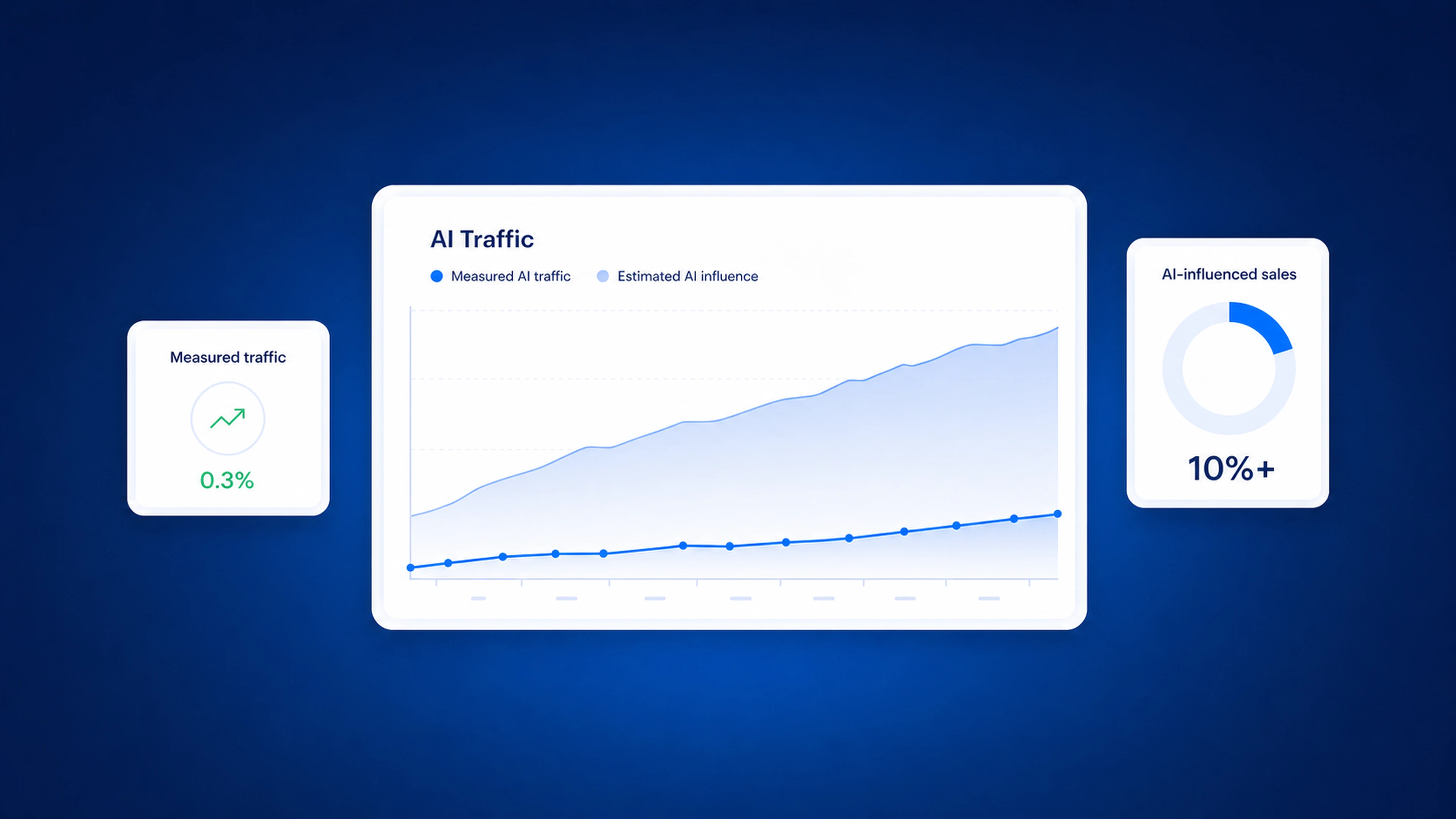
- Analytics only counts an AI click when the platform passes a referrer or a UTM tag. Most surfaces do not, so recognizable AI referrals were just 0.32% of traffic in a 2026 study of 101,000+ sites.
- Estimates put the unlabelled share of AI traffic at 35% to 70%. One dataset inferred 3.4 times more AI-origin visits than visible referrals.
- The sales gap runs larger. At n8n, a survey found about 9% of conversions were AI-influenced against roughly 1% credited by last-touch analytics.
- Measured, inferred, and influenced are different numbers. Visibly AI shows what your analytics can prove next to an evidence-based estimate of what it misses.
AI has become a major discovery channel, but most analytics dashboards barely show it. Usage is huge, referral traffic looks tiny, and the gap comes down to what analytics can actually see.
AI usage is huge, but visible referrals are still small
There is no reliable count of unique AI users worldwide because platform audiences overlap. Still, the scale is clear. ChatGPT has reported more than 900 million weekly users. Google reported 950 million monthly Gemini users and more than 2.5 billion monthly users for AI Overviews.
Similarweb estimates that generative AI platforms received an average of 9.5 billion web visits per month between June 2025 and May 2026. That does not include every native app, desktop product or API.
Yet recognizable AI referrals represented only 0.32% of website traffic in a 2026 study of more than 101,000 sites. That measures identifiable clicks, not AI-assisted discovery.
Why analytics misses AI traffic
Here, AI traffic means human clicks from an AI answer, not visits to chatbots, crawler requests or sales merely influenced by AI. Analytics identifies those clicks through a browser referrer or a campaign tag such as utm_source=chatgpt.com. A site owner cannot normally tag an organic citation. The platform must do it.
Platform testing by SearchPilot shows how inconsistent this remains:
AI surfaceWhat analytics usually seesChatGPT SearchCitations often add utm_source=chatgpt.com. A surviving referrer can also identify ChatGPT.PerplexityWeb clicks usually pass a referrer, but there is no standard UTM.Gemini, Claude and CopilotBrowser clicks may pass a referrer. Apps and desktop clients often lose it.Google AI Overviews and AI ModeClicks can blend into Organic Search or Direct.GrokMany clicks arrive without a usable referrer and appear as Direct.
Google Analytics added an AI Assistant channel in May 2026, but it still needs a recognized referrer. Stripped and copied links remain Direct, while Google excludes its own AI search surfaces from the AI Assistant channel.
The source can also disappear when a purchase happens later or on another device. A shopper may ask ChatGPT for a recommendation, then search for the brand on Google days later. The visit is counted, but Google or Direct gets the credit.
How large is the measurement gap?
Published estimates put the share of AI traffic that standard analytics fails to label at about 35% to 70%. In other words, only about 30% to 65% may be visible. The range is directional, not a global rule.
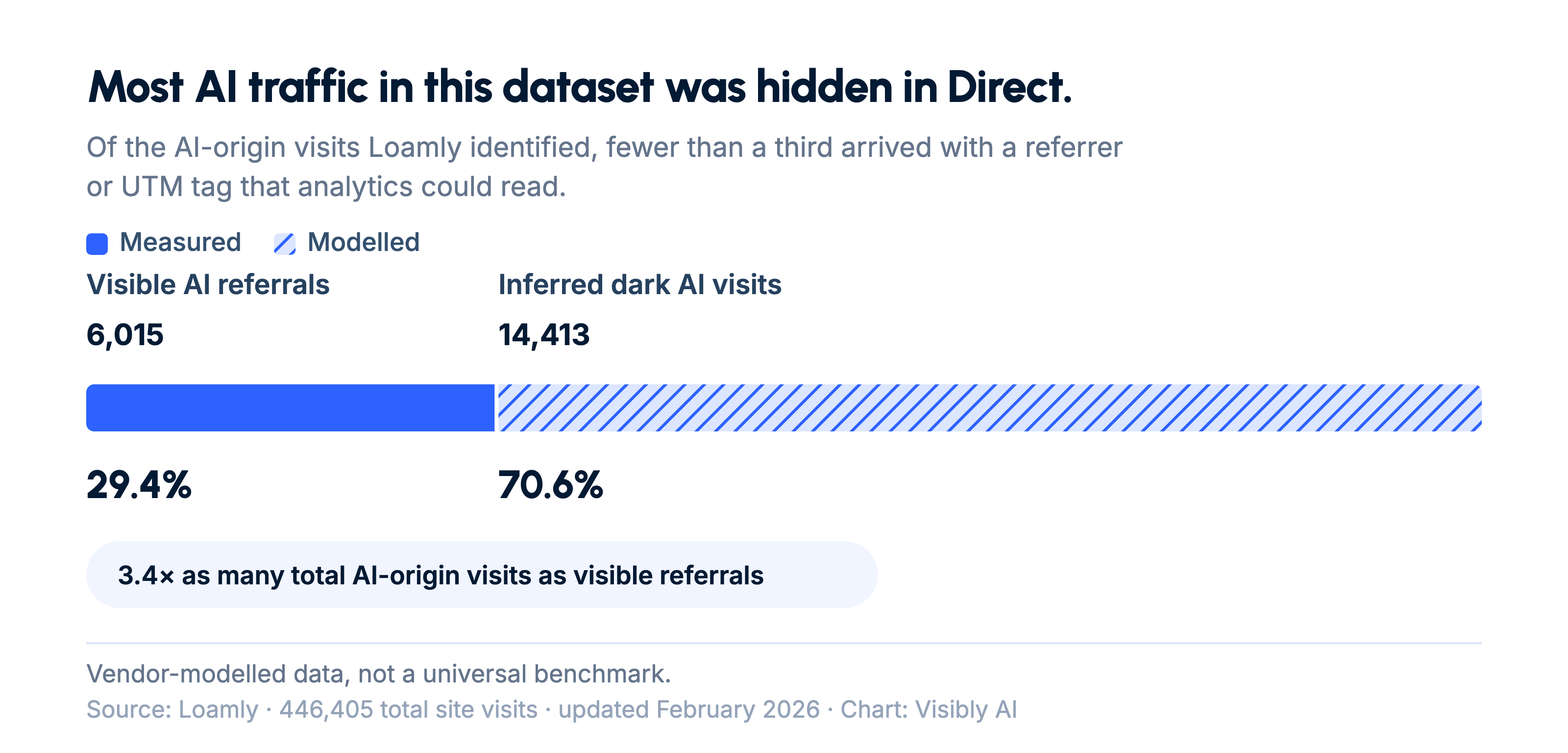
In 446,405 visits, Loamly's vendor model inferred 14,413 hidden AI visits alongside 6,015 visible referrals. That implies 3.4 times as many total AI-origin visits. Since it relies on behavioral signals, this is an estimate rather than proof of origin. A short Gemini iOS test found 56 server-log visits versus five in Google Analytics, but it covered only one app surface.
Sales can show a larger gap. At n8n, Google Analytics credited roughly 1% of conversions to AI, while a post-conversion survey reported about 9%. The case study says 90% of those AI-influenced conversions involved no citation click and appeared as Direct. For n8n, AI's sales impact was understated by roughly 9 to 10 times. It is one B2B case, but it shows why the sales gap can be much larger than the click gap.

ChatGPT users behave differently from Google users
Google traditionally helps people find and compare pages. ChatGPT tries to combine the useful information into one answer, then lets the user refine it through follow-up questions.
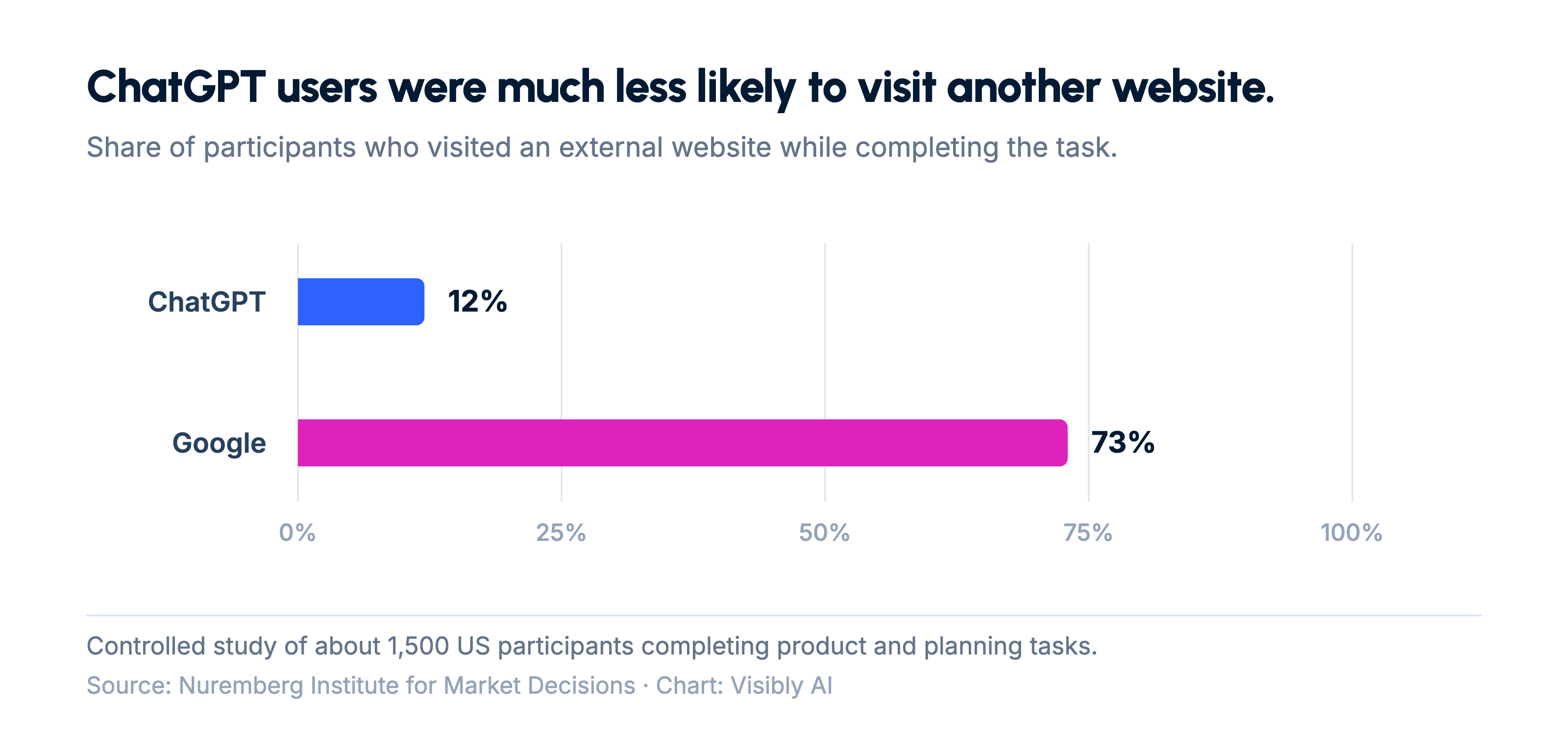
That changes click behavior. In a controlled study of about 1,500 US participants completing product and planning tasks, 12% of ChatGPT users visited an external website, compared with 73% of Google users.
There is no proof that Google or OpenAI is deliberately hiding links. ChatGPT made brand names more visibly clickable in 2026, followed by a 158% weekly increase in measured referrals. The bigger change is that users have fewer reasons to leave. Research and comparison can now happen inside the conversation.
What this means for ecommerce
A peer-reviewed study of 973 ecommerce sites, 10.5 billion sessions and $20.6 billion in revenue found that identifiable ChatGPT traffic represented less than 0.2% of visits. It performed better than paid social and was particularly useful for complex products, although organic search still converted better after controls.
Adobe found that AI-referred traffic to US retail sites grew 393% year over year in the first quarter of 2026. By March, those visitors converted 42% better than non-AI traffic.
Brands should separate measured AI revenue from AI-influenced revenue. Measured revenue follows a referrer or UTM. Influenced revenue includes customers who used AI to decide, then returned through Google or Direct. A post-purchase survey linked to the order can help find that missing influence.
How much global ecommerce is already influenced by AI?
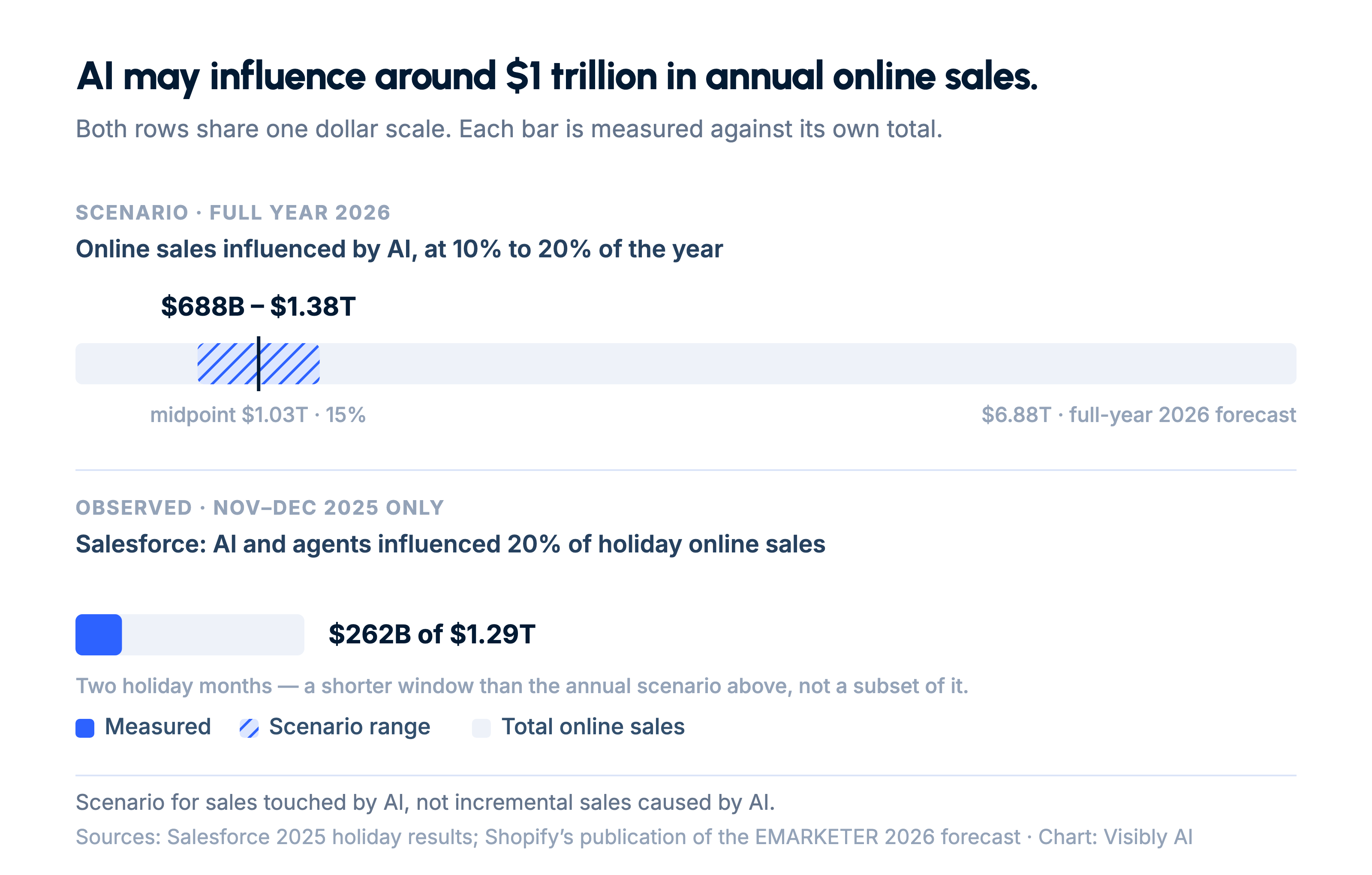
There is no audited global total. The clearest scale marker comes from Salesforce, using activity from more than 1.5 billion shoppers across 89 countries. It estimated that AI and agents influenced $262 billion, or 20%, of $1.29 trillion in global online sales during November and December 2025. That includes recommendations and conversational services, not just assistant referrals.
Worldwide ecommerce is forecast to reach $6.88 trillion in 2026. Applying a 10% to 20% influence scenario gives a range of about $700 billion to $1.4 trillion. The lower end halves Salesforce's holiday share. The upper end carries it across the year.
Roughly $1 trillion is therefore a useful midpoint for annual online sales influenced by AI as of mid-2026. It is a scenario, not a measured total or $1 trillion of new revenue caused by AI.
The bottom line
Measured AI referrals are a floor. Broader datasets suggest that actual AI-origin visits may be 1.5 to 3.4 times the visible figure, while individual app tests have found gaps above 10 times.
For sales, n8n shows that AI influence can be around 9 to 10 times the number credited by last-touch analytics. At market scale, a reasonable 2026 scenario is $700 billion to $1.4 trillion of AI-influenced ecommerce, centered near $1 trillion. These figures measure different things and should not be multiplied together.
Using Salesforce's broad definition of influence, which includes AI recommendations and conversational services as well as assistant referrals, it is reasonable to assume that AI already influences more than 10% of online sales today. That is conservative beside Salesforce's 20% global holiday benchmark. This share is likely to grow quickly as AI assistants move further into product discovery, comparison and checkout.
See the measured and estimated impact with Visibly AI
Visibly AI connects to Google Analytics or Shopify Analytics and pulls traffic data from your site. It shows the exact AI-referred traffic your analytics can measure, then estimates hidden AI traffic and AI-influenced sales. The estimate uses your measured AI referrals, organic traffic and current industry benchmarks.
No model can recover every journey. Visibly AI gives you a grounded indicator of the traffic and revenue likely to be hidden inside Direct or Organic Search. It puts the numbers your analytics can prove next to an evidence-based estimate of what normal attribution is likely to miss.
References
- OpenAI: The next phase of education for countries
- Google: Alphabet Q2 2026 earnings remarks
- Similarweb: Generative AI platform traffic and audience statistics
- SE Ranking: AI traffic research study
- SearchPilot: How AI traffic appears in analytics
- Google Analytics: AI Assistant channel
- Google Analytics: Default channel definitions
- Patrick Stox: AI search measurement and reporting
- Loamly: What Google Analytics gets wrong about AI traffic
- Wheelhouse DMG: AI traffic attribution gap
- Graphite and n8n: Last-touch attribution captures 10% of AEO conversions
- Nuremberg Institute for Market Decisions: ChatGPT versus Google user behavior
- Similarweb: ChatGPT's clickable-link change and referral growth
- Marketing Science: ChatGPT referrals to ecommerce websites
- Adobe: Generative AI traffic to US retail websites
- Salesforce: 2025 global holiday shopping results
- Shopify and EMARKETER: Global ecommerce sales forecast for 2026