TL;DR
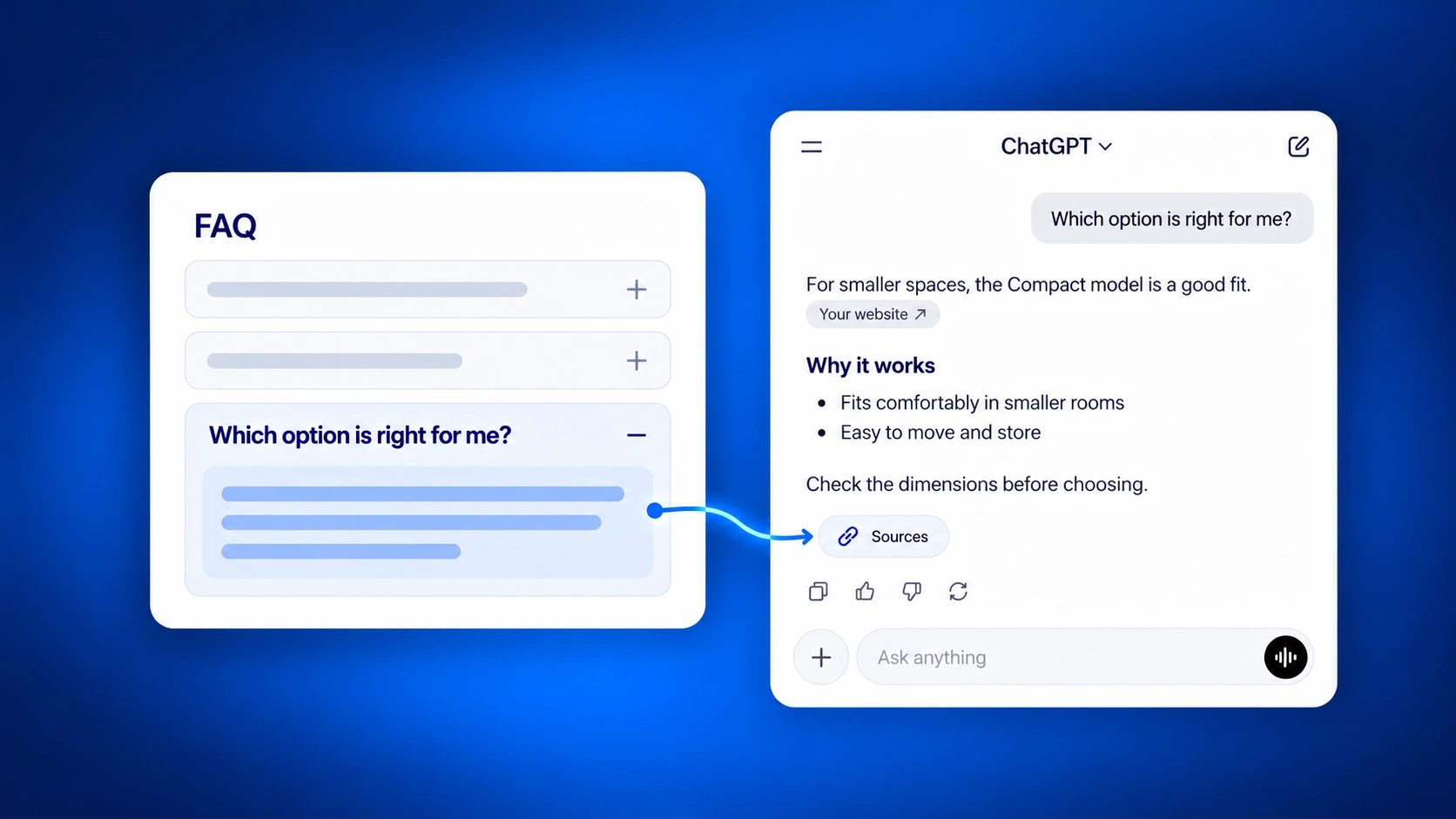
- Answer the questions people actually ask. AI search queries are getting longer and more specific, and an FAQ makes the link between a customer’s need and your product explicit.
- Make each answer stand on its own. Bing recommends FAQ-style content and concise sections. Include the product name, the relevant facts and any important caveat.
- We saw it work. After Le French Wine Shop added an FAQ to its Wine Club page, its mention rate for a tracked prompt rose from 38% to 88% in a week (+132%) and reached 100% the week after (+163% over two weeks, across 24 ChatGPT and Gemini answers) — and its own page became the top cited source in both.
- Measure the change. Record what you changed, track the same prompts over repeated runs, and look at mentions and citations separately.
When a brand asks where to start with AI visibility, I’d look at the questions its website leaves unanswered.
Your customers want to know whether a product fits their needs, how it compares with alternatives, and what its limitations are. A useful FAQ puts those answers where people — and the search systems AI assistants use — can find them.
That makes FAQs a practical place to start. Here’s why, and how I’d approach them.
1. Start with the questions people actually ask
A collection page might describe your products beautifully without answering a basic buying question: “Which of these is suitable for a small apartment?”
An FAQ gives you room to answer it directly. Name the relevant products, explain why they fit, and mention any constraints. You’re making the connection between a customer’s need and your product explicit.
Google’s guidance on succeeding in AI search says people are asking longer, more specific questions. That’s a good reason to move beyond broad category descriptions.
2. Make the answer easy to find and use
A good FAQ keeps the question and its answer together. Readers can get what they need without piecing it together from several paragraphs.
Microsoft’s Bing Webmaster guidance recommends FAQ-style content, descriptive headings, and concise sections to help information be understood and referenced in AI answers.
My takeaway: write an answer that makes sense on its own. Include the product name, the relevant facts, and any important caveat. “Yes, absolutely!” tells a reader very little without the surrounding context.
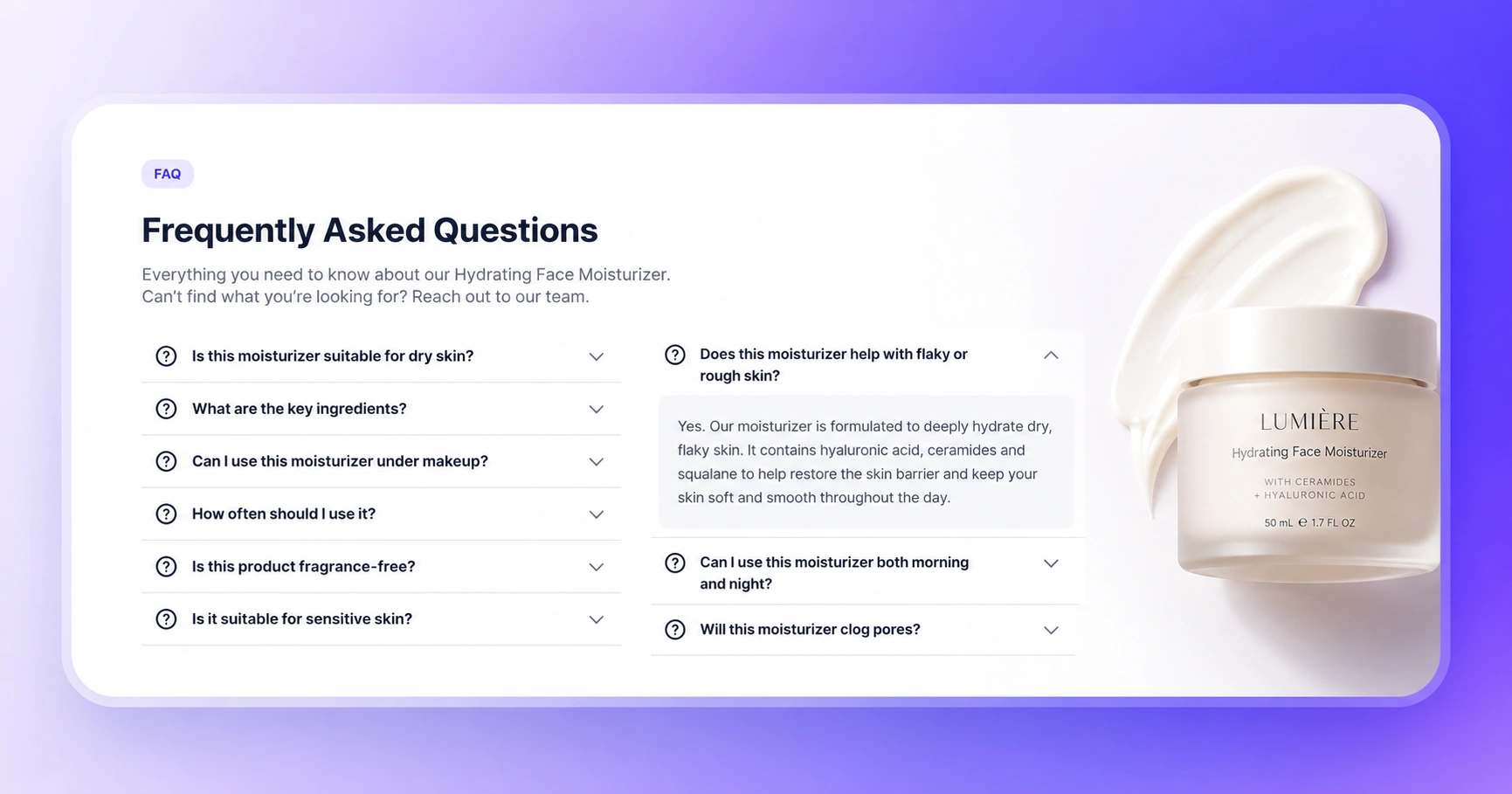
An illustrative example of a good product FAQ: each question is one a shopper would actually ask, and the expanded answer opens with a direct “Yes,” names the product and backs the claim with specific ingredients.
3. The research supports testing FAQs
A Semrush study published in January 2026 compared AI-cited pages with pages ranking in Google for related searches. Q&A formatting was more strongly represented in the cited group.
Its reported 25.45% figure describes a difference in content scores between the groups. It does not mean adding an FAQ increases citations by 25.45%.
That distinction matters. The study gives us a reason to test clear question-and-answer content. It doesn’t tell us what result any individual brand will get.
4. What we saw at Visibly AI: +132% in one week
Le French Wine Shop, a Visibly AI client, tracks the prompt “What are the best French wine subscription clubs in 2026?” We added an FAQ section to the landing page of its Wine Club that answers the questions shoppers ask when choosing a wine subscription.
On September 7, before the FAQ, the brand was mentioned in 38% of AI answers to that prompt. On September 14, after the FAQ went live, it was mentioned in 88%: a 132% increase week over week. On September 21, it was mentioned in 100% of answers: a 163% increase over two weeks.
Each weekly run analyzed 8 AI answers to the prompt: 4 from ChatGPT and 4 from Gemini. The brand appeared in 3 of 8 answers on September 7, 7 of 8 on September 14 and all 8 on September 21 — 24 answers analyzed over the three runs.
The sources changed too. lefrenchwineshop.com became the top cited source for this prompt, and both ChatGPT and Gemini take their information directly from the Wine Club page we edited. Neither cited that page before the FAQ was added.

Le French Wine Shop’s prompt in the Visibly AI Shopify app, Aug 21 – Sep 21: mention rate climbing after the FAQ went live, with its own site the top cited source in ChatGPT and Gemini.
These are relative increases: in percentage points, the mention rate rose by 50 points in one week and 62 points over two. Because AI answers vary from run to run, we never judge a prompt on a single answer. Here, the rate climbed across three consecutive runs, every answer from both ChatGPT and Gemini mentioned the brand by September 21, and the citations moved to the page we edited at the same time. That’s a consistent signal, not one lucky answer: the page we changed is now the page AI quotes when it recommends the brand.
5. Where guides and blog articles fit
Some questions need more space than an FAQ can reasonably give them.
Use a guide when someone needs help choosing, comparing, or doing something. Use a blog article when you have original data, a useful explanation, or a point of view to share.
Then connect that depth to your product pages. A collection-page FAQ can give the short answer and link to a guide for the details. Choose the format based on what the reader needs to understand.
6. How I’d write a useful FAQ
Start with a handful of questions from customer conversations, support requests, and the prompts you’re tracking.
- Put each question on the page where its answer belongs.
- Answer it in the first sentence, then add the necessary detail.
- Use specific facts: dimensions, compatibility, materials, use cases, or limitations.
- Include evidence for claims and update answers when products change.
Keep the answers available as readable page text. Google’s AI features documentation says no special schema is required for its AI features. An FAQ still needs useful content and a page that search engines can access.
7. Measure whether the change helps
Record what you changed and when. Track the same prompts across repeated runs, keeping the platform and testing conditions as consistent as possible.
Look at brand mentions and source citations separately: a link to your page and a recommendation of your product tell you different things. Check whether any improvement lasts beyond the first week. Our guide to measuring AI visibility covers these metrics in more detail.
I’d start with one important page and a few unanswered customer questions. Publish clear answers, measure what happens, and use that evidence to decide what to improve next.